
Table of Contents
Insights from Elevate & Examine, Episode Three
There has never been more content available to us.
Businesses publish articles, videos, podcasts, newsletters, social media posts, reports, webinars, and downloadable guides every day. Creators are producing across multiple platforms, often several times a day, while artificial intelligence has made it possible to generate even more material in less time.
The result is an online world where nearly everyone is publishing, but far fewer people are being remembered.
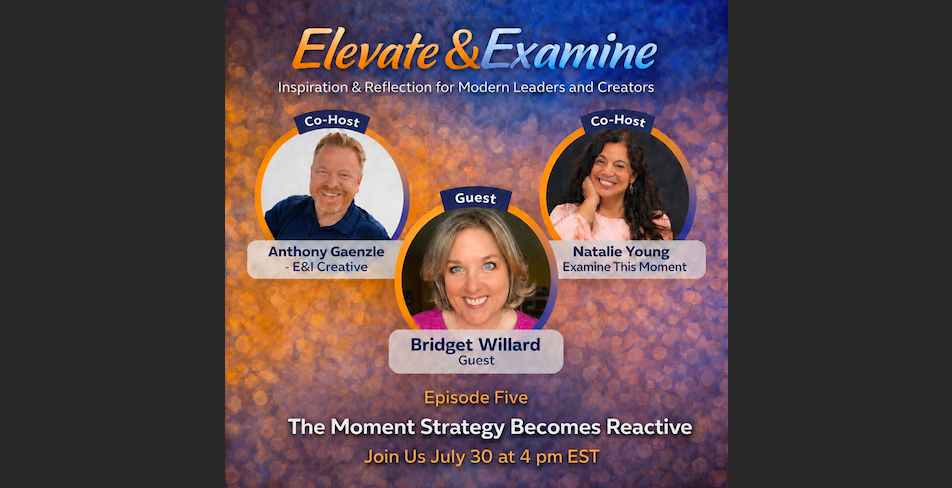
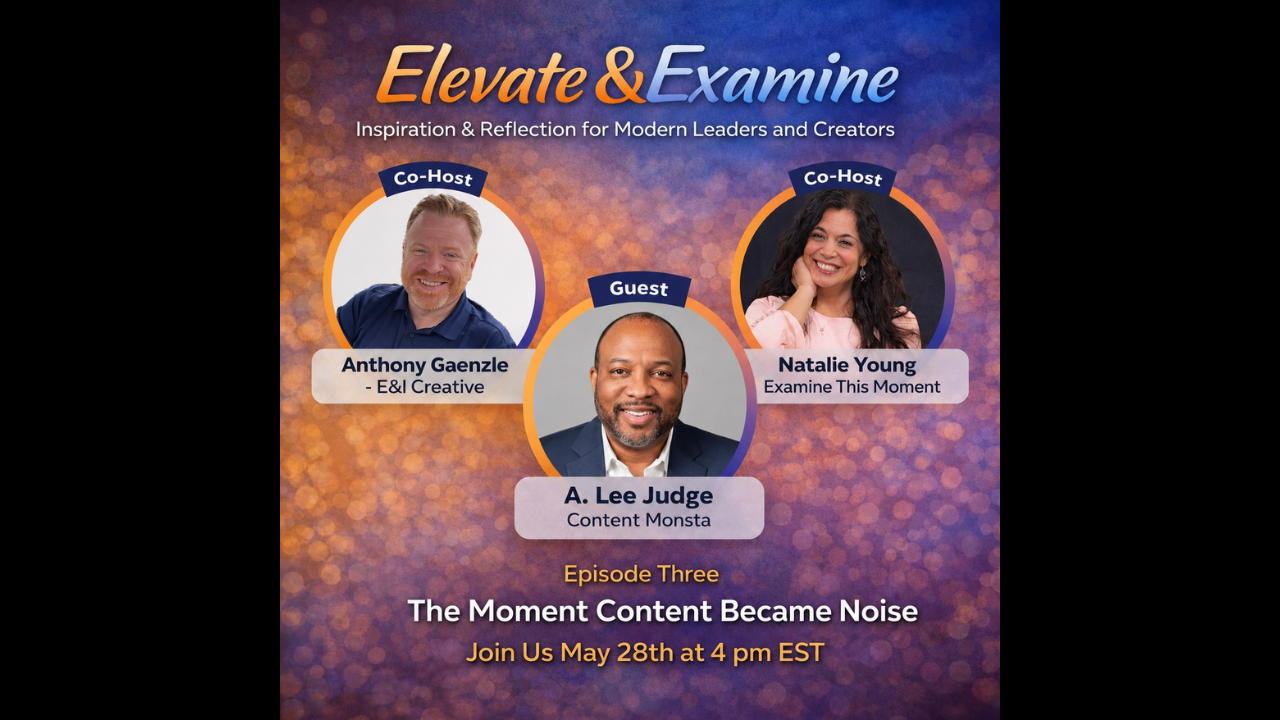
That was the focus of Episode Three of Elevate & Examine. Co-hosts Anthony Gaenzle, founder of E&I Creative, and Natalie Young, founder of Examine This Moment, were joined by A. Lee Judge, founder of Content Monsta and host of The Business of Marketing podcast.
The conversation explored the moment content began to feel like noise, why quality and quantity shouldn’t be treated as opposing goals, how AI can support rather than replace human creativity, and what creators need to understand before attempting to build a business around their work.
The discussion also returned repeatedly to one important idea: producing more content doesn’t automatically make your voice clearer.
More Content Hasn’t Necessarily Created More Value
Content marketing remains one of the most useful ways for businesses and individuals to educate audiences, build trust, and demonstrate expertise.
The challenge is that nearly everyone has received the same advice.
Publish consistently.
Be visible.
Create video.
Start a podcast.
Post on social media.
Build a newsletter.
Each recommendation can be useful, but the collective result is an enormous volume of content competing for a limited amount of attention.
During the episode, Anthony noted that he had published close to 190,000 posts on X since joining the platform in 2012. Multiply that kind of activity across millions of users, then add blogs, podcasts, videos, and every other form of digital media, and it becomes easy to understand why so much content begins to blend together.
Natalie emphasized that brands and creators still need to find ways to communicate what makes them distinct.
“I think something that’s really important is that, you know, we remain authentic. We remain intentional. We remain consistent that we, you know, when we’re telling whatever it is that we’re posting or we’re putting out there that we’re staying true to who we are.” – Natalie Young
Standing out doesn’t always require a completely new topic.
It often requires a recognizable perspective.
Thousands of people may discuss content marketing, leadership, entrepreneurship, artificial intelligence, or personal branding. The differentiator is how each person connects the topic to their experience, values, audience, and point of view.
When that perspective disappears, content begins to sound interchangeable.
Copying What Works Is the Fastest Way to Disappear
Social platforms make it easy to see what appears to be performing well.
A certain post format receives thousands of reactions. A phrase begins appearing in everyone’s opening line. One creator develops a recognizable style, and dozens of others begin producing nearly identical versions.
There is nothing wrong with studying effective content. Creators should observe what holds attention, encourages conversation, and communicates an idea clearly.
The problem begins when inspiration becomes imitation.
Anthony described seeing the exact same posts published by different people, sometimes only a few spaces apart in the feed.
“That’s not the way to stand out. It’s the quickest way to blend in, and who wants to blend in today, you know?” – Anthony Gaenzle
Reposting someone’s work with credit can introduce a useful idea to your audience. Quoting someone and adding your perspective can create a new conversation.
Copying another person’s words or structure without contributing anything original only adds to the noise.
The content may technically increase your publishing volume, but it does nothing to help the audience understand who you are or why your perspective matters.
Finding and developing an authentic voice is far more valuable than borrowing a format that already belongs to someone else.
Your Audience Needs a Reason to Care
A strong personal brand isn’t built by repeatedly telling people how accomplished you are.
It develops when people understand how your experience, ideas, or services connect to something they care about.
Anthony explained that creators need to identify the qualities that make them different and clearly connect those qualities to the needs of their audience.
“We all bring something to the table that’s unique. We all bring a lot of things that are the same. So, figure out what that thing is that really makes you unique and clearly and consistently explain to your audience why they should care and why it matters to them.” – Anthony Gaenzle
That last part is essential.
A creator can have an interesting story, valuable credentials, and deep expertise. None of those things automatically make the content relevant to another person.
The audience is still trying to answer a question:
What does this mean for me?
The same principle applies when selling a product. People may need to understand its features, but those features become meaningful when they can see how the product saves time, reduces stress, solves a problem, or improves their situation.
Your content should create that connection.
Instead of publishing only to be seen, create something that leaves value wherever it appears.
Attention Without Intention Adds to the Noise
Attention is often treated as the primary measure of content success.
Creators watch views, impressions, reactions, shares, and follower counts. Marketing teams report reach and engagement. Platforms encourage people to publish more frequently so they remain visible.
Those numbers can provide useful information, but attention alone doesn’t tell you whether the content is helping you achieve anything meaningful.
Natalie encouraged creators to consider what kind of attention they are trying to attract and why they want it.
“What kind of attention do we want to create? You know, when we’re with the messages that we’re putting out there, what kind of attention do we want to create?” – Natalie Young
She then connected attention with purpose.
“So, my intention must remain goal-oriented and consistent.” – Natalie Young
The goal shouldn’t be to attract everyone.
It should be to attract and hold the interest of the people who are most likely to connect with your message, benefit from your expertise, or become part of the community you are trying to build.
Content created only to generate a temporary reaction may disappear as quickly as it arrived.
Content created with intention has a better chance of strengthening a relationship.
Consistency Doesn’t Mean Publishing Constantly
Consistency is one of the most repeated recommendations in content marketing, but the word is often misunderstood.
Some creators interpret it as a requirement to publish as much as possible. They feel pressure to post several times a day, respond to every trend, and maintain a presence on every platform.
That pace may increase output, but it can also reduce thoughtfulness.
Anthony explained that standing out often requires repeating less exciting work over a long period.
“If you really want to stand out, you know, you have to do sometimes sort of those boring, consistent, tedious things over and over and over, and that’s not to say just repeating yourself over and over. You have to have that purpose built into it, and you have to understand your audience, but you have to be willing to stay the course and keep putting yourself out there for a long time before it really sticks.” – Anthony Gaenzle
Consistency is less about publishing every few minutes and more about showing up with a recognizable message over time.
Your audience probably won’t understand who you are after seeing one post.
They begin to form that understanding through repeated interactions. Each post, article, video, podcast appearance, or conversation adds another piece to the picture.
Those interactions need to feel connected.
As Natalie put it:
“Inconsistency will speak very loud, just as much as consistency will.” – Natalie Young
A sustainable cadence gives creators enough room to produce meaningful work while remaining present. That might mean a few thoughtful posts each week rather than a rushed post every hour.
The right publishing schedule is one you can maintain without lowering the quality of everything you create.
Building that kind of visibility over time matters more than chasing a short burst of attention and disappearing.
Audiences Have Learned to Ignore Meaningless Content
People consume so much information that filtering has become a survival skill.
They scroll past generic advice. They skip introductions that take too long to reach the point. They ignore content that looks like something they have already seen dozens of times.
This isn’t necessarily because audiences have shorter attention spans.
They may simply have higher standards for what deserves their attention.
Natalie observed:
“Audiences out there, like even right now, anyone that’s listening to us, you know, for example, where we get conditioned to tune out meaningless content. Let’s be honest. You know, we will tune it out.” — Natalie Young
Anthony acknowledged that many creators and marketers have fallen into the trap of believing that success comes from producing the greatest possible volume.
“I’ve been guilty through the years of creating it. I mean, we’ve all been there where we thought, you know, it’s all about just churning out content. It’s about just putting out the most content and that’s not the case.” – Anthony Gaenzle
Audiences can usually sense whether a creator has put meaningful thought into a piece of content.
That doesn’t mean every post needs to become an in-depth research project. A brief observation can be valuable when it expresses something clearly and gives the reader a useful idea.
The issue isn’t length.
It’s whether the content has a reason to exist.
Quality and Quantity Shouldn’t Be Opposing Goals
When A. Lee Judge joined the conversation, Anthony asked how brands and individuals could rise above the growing “sea of sameness.”
Lee’s answer challenged the common argument that creators should choose quality over quantity.
“Yeah, well, I’ll tell them that they need two things and that’s quality and quantity. And I know often they’re told that we don’t need more content, but the real advice should be that we don’t need more low-quality content because to rise above the noise, you need that quantity.” – A. Lee Judge
High-quality content that appears once every few months may not give an audience enough opportunities to discover or remember a brand.
At the same time, a large volume of low-quality material can weaken credibility and cause people to ignore future content.
Businesses need both.
Lee described a framework that combines context, human viewpoints, and AI to produce quality content at scale.
The context helps ensure the content is tied to the audience, business, and situation.
The human viewpoint provides the original experience, opinion, and perspective.
AI can then help organize, refine, and distribute those ideas more efficiently.
The goal isn’t to flood every platform with machine-generated content.
It is to remove some of the barriers that once forced smaller businesses to choose between creating one polished piece or maintaining enough output to stay visible.
AI Isn’t Taking Your Creativity if You Don’t Give It Away
Artificial intelligence is often blamed for the increasing amount of generic content online.
That concern has some merit. When people ask the same tools to generate articles, posts, and scripts from similar prompts, the results can begin to sound the same.
Lee argued that the problem isn’t necessarily the technology.
It is how people choose to use it.
“I don’t think AI takes your creativity. I think too many people are giving it to AI. They’re giving it away. They’re not utilizing it themselves.” – A. Lee Judge
AI produces generic work when creators ask it to supply the ideas, experience, opinions, and conclusions.
Those are the parts that should come from the person.
Lee recommended starting with your own creativity, thoughts, and experiences. Once that raw material exists, AI can help with framing, organization, and clarity.
Framing helps turn a collection of notes into a clear angle.
Organization creates a logical flow from ideas that may have appeared in a scattered order.
Clarity tightens the language so the audience can understand the point more efficiently.
None of those tasks requires AI to replace the creator’s viewpoint.
The real opportunity comes from combining AI with human creativity rather than handing over the entire creative process.
Use AI to Extract Your Ideas, Not Invent Them
Lee shared an AI interview process he uses to develop content from his own expertise.
Instead of asking a tool to write an article on a broad topic, he has the AI ask him questions one at a time. He responds with his own experiences, opinions, and explanations, sometimes continuing the interview for 15, 20, or 30 minutes.
The AI is collecting original material rather than inventing it.
“And so, it won’t be the same as anybody else because I’m not the same as anybody else. I have my own opinions, my own stances.” – A. Lee Judge
Once the interview is complete, the tool can help identify themes, move ideas into a clearer order, and flag information that may not belong.
The original substance still comes from Lee.
He summarized the relationship clearly:
“AI is just my interviewer, my writing coach, my editor, but it is not my creator.” – A. Lee Judge
That distinction offers a practical model for businesses and creators concerned about losing their voice.
AI can help you communicate more effectively without deciding what you believe.
It can support creativity without becoming the source of it.
But that only happens when the human remains involved.
The challenge is to let AI amplify your voice rather than replace it.
Avoiding AI Won’t Stop the Change
Some professionals remain hesitant to adopt AI because of concerns about jobs, originality, ethics, or the speed of technological change.
Those concerns shouldn’t be dismissed. The impact of AI is significant, and many people are already experiencing disruption.
At the same time, refusing to learn how the technology works may create additional professional risk.
Lee compared AI with foundational technologies such as electricity and the internet.
“To me at this point it’s electricity, it’s the internet, it’s how we do business, it’s an amazing tool.” – A. Lee Judge
The speed of the current shift makes it different from earlier technological changes.
Traditional education often works in two- or four-year periods. AI capabilities can change dramatically within a much shorter window.
Lee explained:
“Two years from now with AI is going to be 20, 30 years of difference what we’re used to. So, we don’t have time to take, you know, to go back to school for four years to change. We have to figure out what’s going on now.” — A. Lee Judge
Creators and business leaders don’t need to adopt every new tool immediately.
They do need to understand what the technology can do, where it can improve their work, and where human judgment must remain in control.
Consumers Want to Be Helped, Not Sold
The conversation then shifted from the people producing content to those consuming it.
With so many formats, platforms, brands, and creators competing for attention, what are audiences actually looking for?
Lee’s answer returned to a longstanding principle of effective marketing.
“I think consumers want to be helped and not sold. They want information.” – A. Lee Judge
People research on their own terms.
They compare options, watch videos, read reviews, listen to podcasts, follow experts, and gather information before speaking with a company.
Useful content helps them move closer to a decision.
That doesn’t mean every piece needs to contain a sales pitch. In many cases, the content becomes more effective when it focuses on answering the question in front of the audience rather than pushing immediately toward a transaction.
Lee continued:
“Some may rather have humor or straightforwardness, but in the end it’s about how can you help me get closer to a decision I’m going to make?” – A. Lee Judge
The style may change depending on the audience.
The value should remain.
This reflects how modern buyers move through multiple conversations and touchpoints rather than following a perfectly linear marketing funnel.
Let the Audience Choose the Format
Businesses often select content formats based on internal preferences.
A team enjoys writing, so it produces only blog posts.
A founder feels comfortable on camera, so every idea becomes a video.
A creator enjoys podcasting and assumes the audience will listen.
The problem is that consumers don’t all prefer the same format.
Some people want to read. Others want to listen while driving or exercising. Others learn more easily by watching someone demonstrate an idea.
Lee explained:
“Our content has to be in the format that the consumer desires, not how we desire to distribute it.” – A. Lee Judge
Demographic assumptions don’t always predict those preferences.
A senior executive may spend time watching YouTube or scrolling TikTok. A younger buyer may prefer an in-depth article or podcast. People don’t always behave in the ways traditional audience profiles suggest they should.
That creates a strong argument for repurposing.
One substantial conversation can become a video, podcast, article, newsletter, short clips, social posts, and visual content. The central idea remains the same, but the format changes based on where and how different people prefer to engage.
Repurposing isn’t simply a way to generate more posts.
It is a way to make valuable information more accessible and to create content that works for both human audiences and digital discovery systems.
Content Entrepreneurship Is Still a Business
The creator economy has made it possible for individuals to generate revenue through subscriptions, sponsorships, platform payments, courses, books, consulting, and digital products.
It has also created the impression that enjoying content creation is enough to build a sustainable business.
Lee made an important distinction.
“Yeah, I think it’s absolutely possible, but if and only if they understand that an entrepreneur is a business endeavor, not a creative one.” – A. Lee Judge
A creator may begin by publishing whatever feels interesting.
A business eventually requires decisions about audience demand, pricing, products, positioning, operations, sales, and profitability.
The content can no longer be based only on what the creator enjoys making.
“And there’s going to be a point when the content is no longer about you or what you like, and that’s when the game changes and starts to become work. So, you have to be ready for that part.” – A. Lee Judge
That doesn’t mean the creativity disappears.
It means creativity becomes part of a larger system designed to serve an audience and generate revenue.
A topic can be fascinating without representing a viable business. Creators need to determine whether enough people care about the subject, whether those people have a problem worth solving, and whether they are willing to pay for a solution.
Passion can start the journey.
Business discipline is what makes it sustainable.
Always Know What Comes Next
To close the guest segment, Anthony and Natalie asked Lee to share five lessons for people who want to build similar success as entrepreneurs and creators.
His first recommendation was to prepare for what happens after the current plan succeeds or fails.
“Always have a plan for what’s next, if things work and if they don’t work, because there’ll always be sometimes when it doesn’t work.” – A. Lee Judge
The next move doesn’t always need to be a completely separate Plan B.
It simply needs to prevent one outcome from leaving the business directionless.
Successful experiments create new questions. Failed experiments provide information. Both should lead somewhere.
Self-Motivation Is Part of the Job
Entrepreneurship removes many of the structures people experience in traditional employment.
There may be no manager assigning the next task, setting the deadline, or deciding what deserves priority.
That freedom can be appealing, but it also requires discipline.
“Self-motivation, that’s a must. If you’re used to being someone having someone tell you what to do next, entrepreneurship isn’t for you.” – A. Lee Judge
Entrepreneurs need to take action when they don’t feel motivated.
They also need to determine what action to take when the next step isn’t obvious.
That ability is as important as creativity.
Financial Reserves Protect Good Ideas
A promising business idea may take time to gain traction.
Without savings or sufficient cash flow, entrepreneurs can be forced to abandon a sound direction before it has a chance to work.
Lee advised creators and business owners to prepare financially for slower periods.
“Save, save, save. Save money because there’s going to be droughts and you don’t want to have to change direction of your business when things slow down.” – A. Lee Judge
When money becomes tight, entrepreneurs often jump toward a new idea they hope will generate faster results.
The new direction also takes time, so they change again.
The pattern continues.
Financial reserves give people the ability to remain patient, evaluate what is happening, and push through a temporary slowdown without making decisions from desperation.
Build a Network Through Curiosity and Helpfulness
Networking is often approached as a transaction.
People attend an event, send connection requests, or start conversations primarily because they want something.
Lee recommended a different approach.
“Network with curiosity. Meet people, connect with interesting people, keep in touch, be helpful to those people. Be a connector, because nobody forgets connectors.” – A. Lee Judge
Introducing two people who can help one another creates value without immediately asking for anything in return.
Those connections can lead to friendships, partnerships, opportunities, and business relationships that extend far beyond a single interaction.
A strong network is not simply a list of people you know.
It is a community of relationships you have taken time to support.
Those relationships also help close the gap between being capable and being known for the value you provide.
Don’t Confuse Time With Value
Lee’s final lesson addressed a challenge faced by consultants, agencies, freelancers, and other service providers.
“The value you bring matters more than the time it took you to bring it. Don’t get those two mixed up or tied together. Your value and your time are two different things.” – A. Lee Judge
Experience often allows an expert to complete something quickly.
That speed shouldn’t automatically make the work less valuable.
The client may be paying for years of learning, the ability to avoid mistakes, a better outcome, or a solution that produces meaningful financial returns.
Pricing only by the hour can penalize expertise by making efficient work worth less.
Time is one input.
Value is the impact the work creates.
Create Enough to Be Seen, but Make It Worth Seeing
The internet doesn’t need more low-quality content.
It does need useful ideas, original experiences, clear explanations, and human perspectives.
Brands and creators shouldn’t use the volume of online noise as an excuse to disappear. Publishing too rarely can make even excellent work difficult to discover.
The answer is to pursue quality and quantity together.
Start with the knowledge and experience only you can provide.
Use AI to extract, organize, and clarify those ideas rather than allowing it to replace them.
Create for the needs of the audience, not simply for the satisfaction of publishing.
Distribute the work in formats people actually want to consume.
And remember that content entrepreneurship eventually requires more than creativity. It requires planning, self-motivation, financial discipline, relationships, and a clear understanding of value.
More content will continue to appear.
The creators and brands that rise above the noise won’t necessarily be the loudest.
They’ll be the ones who give people something worth hearing.

e&i creative is a full-service marketing agency headquartered in Lancaster, Pennsylvania, and serving both B2B and B2C clients across multiple states and regions. The agency offers web design, marketing strategy, social media marketing, graphic design, content marketing, SEO, video production, blogging, and copywriting services.