
Table of Contents
Insights from Elevate & Examine, Episode Five
Most businesses don’t wake up one morning and intentionally abandon their strategy.
It usually happens gradually.
A competitor launches something that gets attention. Engagement drops. Sales slow down. A platform changes. A trend suddenly appears everywhere, and someone asks why the company isn’t participating.
Each moment may feel urgent on its own. Together, they can pull a business away from its original direction.
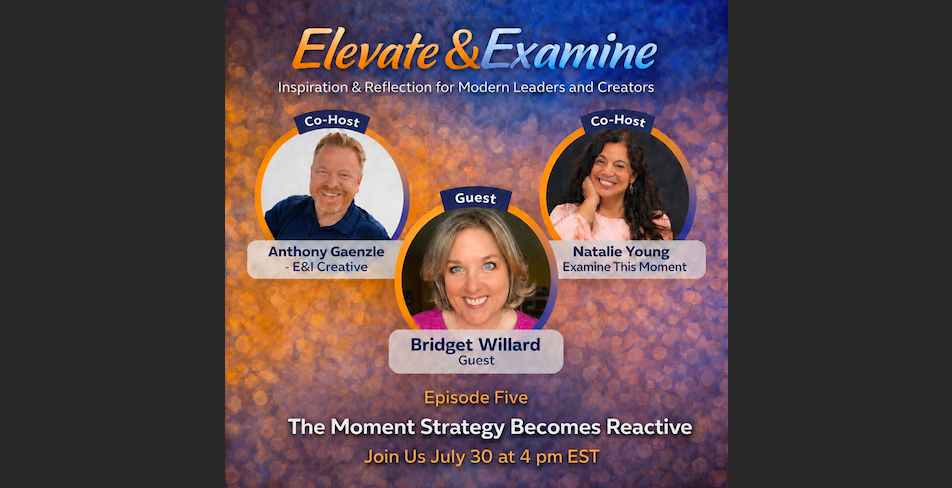
That was the focus of Episode Five of Elevate & Examine. Co-hosts Anthony Gaenzle, founder of E&I Creative, and Natalie Young, founder of Examine This Moment, were joined by SaaS marketing consultant Bridget Willard for a conversation about the moment strategy becomes reactive.
The discussion explored why businesses copy competitors, how emotional decisions weaken long-term positioning, and why getting attention isn’t the same as building recognition and trust.
Responsive and Reactive Aren’t the Same
Businesses need to respond when circumstances change.
Customer expectations shift. New technology emerges. Competitors introduce ideas worth examining. Marketing platforms evolve, and strategies that worked several years ago may no longer produce the same results.
Being adaptable is important.
The problem begins when responsiveness turns into reaction.
As Anthony explained during the episode, strategy becomes reactive when leaders stop asking whether an opportunity aligns with what the organization is trying to accomplish. Instead, they start focusing on what competitors are doing, how quickly they can copy it, or how they can jump on a trend before it disappears.
There’s a meaningful difference between recognizing an important market shift and chasing something because everyone else seems to be doing it.
A responsive company evaluates what changed and determines whether an adjustment supports its goals.
A reactive company feels pressure and moves before it fully understands the situation.
That pressure may create activity, but activity shouldn’t be confused with progress.
Pressure Makes Every Opportunity Look Important
Reactive strategy can be difficult to recognize because it rarely feels irrational in the moment.
It feels urgent.
A campaign isn’t performing as expected. A competitor appears to be gaining ground. A new platform is attracting attention. Someone on the leadership team wants an immediate response.
Natalie identified several reasons businesses fall into this pattern, including pressure to keep up, fear of missing out, an unclear vision, the pursuit of quick results, and listening to too many outside voices.
She also introduced an important idea: comparison over conviction.
When leaders are clear about their identity, audience, values, and long-term direction, they can evaluate outside ideas without being controlled by them. When that clarity is missing, almost every tactic can look like an opportunity.
“Successful leaders don’t chase every trend. They evaluate opportunities through the lens of their mission, their values, and their long-term vision.” – Natalie Young
The problem isn’t that trends and competitor insights are always useless. Paying attention to the market is part of running a healthy business.
The danger is allowing external activity to determine your direction before you’ve decided whether it has any relevance to your business.
Imitation Can Slowly Weaken Your Identity
Businesses don’t always imitate competitors because they lack ideas.
Sometimes they copy because they feel uncertain.
A newer brand may not fully understand its position in the market yet. An established company may know it needs to evolve but have difficulty determining what that evolution should look like.
In either situation, borrowing something that appears to be working for another company can feel safer than developing an original path.
The result is often the opposite.
“The problem is if your strategy is built on imitation, it ends up accidentally, I mean, I would assume most businesses wouldn’t do this intentionally, but it ends up accidentally weakening your identity instead of strengthening it.” – Anthony Gaenzle
Every time you base a decision primarily on what another company is doing, you give that company influence over your positioning.
Over time, your marketing begins to sound like everyone else’s. Your content becomes less recognizable. Your brand loses the qualities that once made it distinct.
The same principle applies to personal brands.
Trying to maintain someone else’s voice, style, or personality is exhausting because it requires you to perform every time you show up. Building from your own experience is far more sustainable.
As Anthony said during the conversation:
“The easiest thing to be is you.” – Anthony Gaenzle
Learning from the market is valuable. Allowing the market to erase your identity is not.
Reactive Decisions Often Begin With Emotion
A sudden pivot may look like a tactical decision, but the motivation behind it is often emotional.
Fear, anxiety, criticism, disappointment, and comparison can all create the feeling that something needs to change immediately.
That feeling is human. It doesn’t automatically mean a leader is weak or unprepared.
The real test is what happens next.
Natalie encouraged leaders to pause and examine what they’re feeling, why they’re feeling it, and whether their response is being shaped by wisdom or emotion.
“Healthy leadership isn’t about never feeling emotional. It’s about learning to steward those emotions well.” – Natalie Young
Emotions provide information, but they shouldn’t always be given authority over a decision.
When leaders react impulsively, the damage may extend beyond a single campaign. Emotionally driven decisions can create unnecessary conflict, weaken business relationships, confuse employees, and lead to changes the organization later regrets.
Thoughtful leadership creates space between the feeling and the response.
That space allows leaders to collect information, seek perspective, and determine whether the situation truly requires a strategic change.
Bridget has used a simple reminder throughout her adult life to help create that space:
“For my whole adult life, I’ve been telling myself this mantra respond, don’t react, respond, don’t react, because a reaction is emotional.” – Bridget Willard
The distinction may sound simple, but it becomes much harder to practice when pressure is building.
That’s why the pause matters.
Not Every Uncomfortable Moment Requires a Pivot
Business growth is rarely comfortable.
Engagement fluctuates. Campaigns sometimes underperform. Competitors make noise. New ideas take longer to gain traction than expected.
Those moments can create doubt, but doubt isn’t always evidence that the strategy is wrong.
One of the most important lessons from the episode was the need to pause before pivoting.
A premature pivot can kill momentum before a strategy has been given enough time to work. It can also send mixed signals to employees and customers who are trying to understand where the company is headed.
Before changing direction, leaders should ask better questions.
What is actually happening?
What are we reacting to?
Has something meaningful changed, or are we responding to temporary pressure?
Does the decision address a real strategic need?
What could the change mean six months or a year from now?
Will it bring the company closer to its long-term position, or send it in another direction entirely?
The goal isn’t to delay every decision. Some circumstances genuinely require quick action.
The goal is to determine whether urgency is coming from wisdom or panic.
As Anthony told listeners:
“Not every loud moment deserves control over your strategy.” – Anthony Gaenzle
Catch Episode One: The Real Impact of AI on Creators and Business Leaders
You Don’t Know Why Your Competitors Are Doing It
Competitor activity is one of the most common triggers for reactive marketing.
A company sees another brand investing heavily in advertising, producing a new type of content, entering a platform, or launching a campaign. Leaders assume the competitor knows something they don’t, and pressure builds to respond.
Bridget challenged the assumptions behind that behavior.
When Anthony asked why companies become competitor-driven instead of remaining rooted in their own strategy, her answer was direct:
“In one word, Anthony, that would be fear.” – Bridget Willard
A company’s visible marketing activity tells you very little about what’s actually happening inside the organization.
You don’t know its revenue. You don’t know its expenses. You don’t know whether the campaign is working. You may not even know the goal behind it.
The company could be experimenting. It could be spending the remainder of a departmental budget. It could be prioritizing rapid growth over profitability. It could be targeting a completely different segment of the market.
It could also be making a mistake.
“You may see someone who you think is a competitor, but you don’t know if those strategies even work or more importantly, if they care that they work, right?” – Bridget Willard
Visible tactics aren’t the same as verified results.
Before copying another company’s approach, leaders should return to the information they can control: their own goals, customer insights, internal communication, documentation, positioning, and marketing plan.
As Bridget explained:
“What you can control is internal communication, internal documentation, internal strategies, whether or not you’re accomplishing your goals according to your own business and marketing plan. Those are the things you can control. Everything else is just a mirage.” – Bridget Willard
The Highlight Reel Isn’t the Whole Business
Social media makes competitor comparison even more dangerous because companies generally share their best moments.
You see the launch, not the months of internal disagreement that came before it.
You see the campaign creative, not the disappointing conversion rate.
You see the growth announcement, not the rising expenses behind it.
You see the polished outcome, not the uncertainty, experiments, and failed attempts.
Businesses can fall into the same comparison trap people experience in their personal lives. Someone appears to be thriving, and we assume their situation must be better than ours.
But appearances offer very little context.
“You don’t even know that they are doing better. Instead, focus back on what you’re doing.” – Bridget Willard
Competitor awareness can help a company understand the broader market.
Competitor obsession shifts attention away from the customers, capabilities, and goals that should guide the strategy.
Use the market as information, not instruction.
Attention Isn’t the Same as Recognition
Trends can produce attention.
A clever response to a viral moment may generate impressions, reactions, and shares. That can feel like success, especially when marketing performance is evaluated one post at a time.
But not all attention has equal value.
Bridget made one of the clearest distinctions of the episode when she explained that brands shouldn’t simply chase visibility.
“You don’t need attention. You need recognition so that you can build trust.” – Bridget Willard
Attention is temporary.
Recognition develops when people repeatedly associate your brand with a relevant idea, problem, solution, or experience. Trust grows when that recognition is supported by consistent actions and useful communication.
A trend may place your company in front of thousands of people who will never become customers. A focused piece of content may reach fewer people while strengthening your reputation with the exact audience you need to reach.
Before chasing a burst of visibility, ask whether it helps the right people understand who you are and why they should trust you.
If it doesn’t, the attention may not be worth much.
Protect the Vision Without Becoming Rigid
Avoiding reactive strategy doesn’t mean refusing to change.
Healthy businesses test ideas. They adjust when evidence shows that something isn’t working. They respond to customer needs and evolve as the market changes.
The difference is where that evolution begins.
Intentional change starts with clarity.
Reactive change starts with pressure.
When leaders understand what the company stands for, who it serves, and what it wants to be known for, they can explore new ideas without losing their direction.
They can ask whether an opportunity strengthens the strategy rather than simply replacing it.
They can learn from competitors without becoming copies.
They can acknowledge emotion without letting emotion control the decision.
And they can move quickly when necessary without treating every uncomfortable moment like a crisis.
Natalie described the importance of protecting that direction during difficult moments:
“So when you’re having all these voices, when you’re seeing your competitors do better than you at that point, when you feel like people are disregarding where you’re going, pressure can tempt you to compromise your values and abandon who you are in what you’re doing in business. So keep focused on your vision, guard against distractions, and continue going forward.” – Natalie Young
Lead From a Grounded Place
Reactive strategy is tempting because it offers short-term relief.
Doing something feels better than sitting with uncertainty. Copying a visible tactic feels safer than trusting a strategy that may take time. Following a trend can make a company feel current, even when the trend has little connection to its customers.
But short-term relief can create long-term confusion.
Strong leaders create enough space to examine what’s happening before they change direction. They listen, collect information, revisit the mission, and separate a meaningful opportunity from a temporary distraction.
They don’t ignore the market.
They simply refuse to let every loud moment lead the business.
The goal isn’t to predict every change or eliminate every emotional response. It’s to build enough clarity that the organization can adapt without losing itself.
Respond when the situation calls for it.
But don’t let fear, comparison, or urgency take control of your strategy.
Catch up on the Elevate & Examine episodes your missed:


e&i creative is a full-service marketing agency headquartered in Lancaster, Pennsylvania, and serving both B2B and B2C clients across multiple states and regions. The agency offers web design, marketing strategy, social media marketing, graphic design, content marketing, SEO, video production, blogging, and copywriting services.