
For years, when we talked about marketing, we were told to think in terms of funnels.
Top of funnel.
Middle of funnel.
Bottom of funnel.
The marketing funnel is neat. It’s predictable. It’s linear. It’s all the things we were taught back in marketing 101.
It’s also increasingly disconnected from how people actually make decisions.
The funnel wasn’t a bad idea. Nothing that sticks around and works for over 100 years is really a bad idea, right?
It gave structure to something that felt chaotic. It helped teams organize messaging, content, and budgets.
But here’s the problem. Times change. People don’t move like funnels anymore.
They move like people. I guess they’ve always technically moved like people, but now, we’re more people-like than ever
Table of Contents
The Traditional Marketing Funnel Assumes Order. Reality Doesn’t.
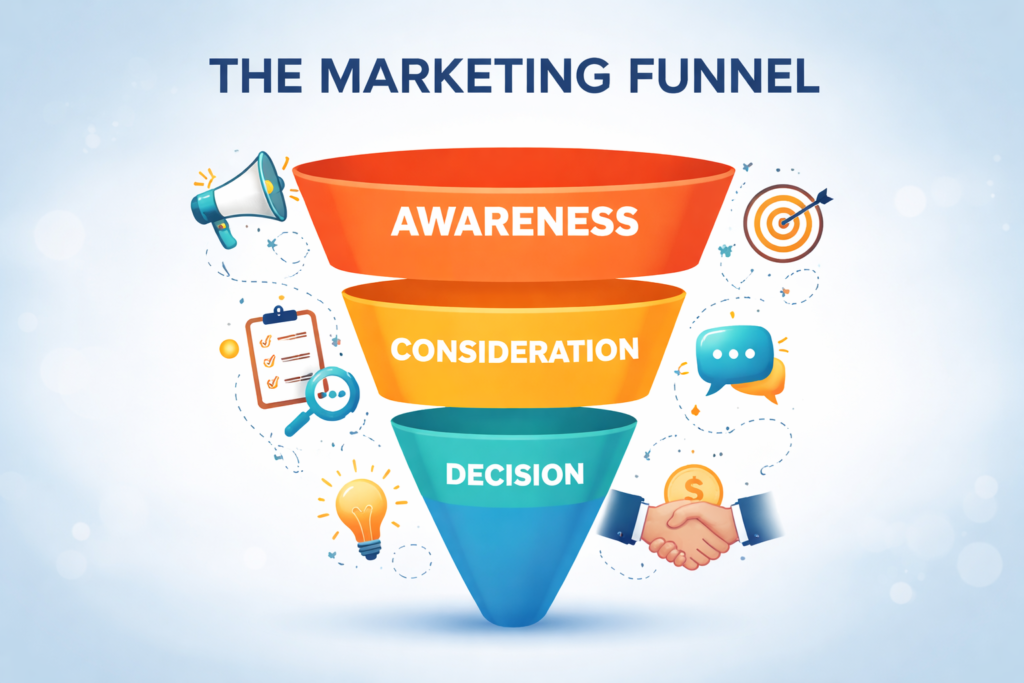
The traditional funnel assumes a sequence.
It starts with Awareness, transitions to Consideration, and winds up with a Decision to work with you, all neat and tidy with a little bow.
That might have worked when:
- Information was limited
- Brands controlled the narrative
- Buyers followed clearer paths
That’s not the world we’re in anymore. Having been in the marketing field for over 20 years, I can tell you that things have changed. They have changed quite a bit.
Today, there are a lot more twists and turns. The path to the final decision might look something like this.
- Discover you on LinkedIn
- Ignore you for three weeks
- See a client mention you in a comment
- Visit your site twice
- Listen to a podcast you were on
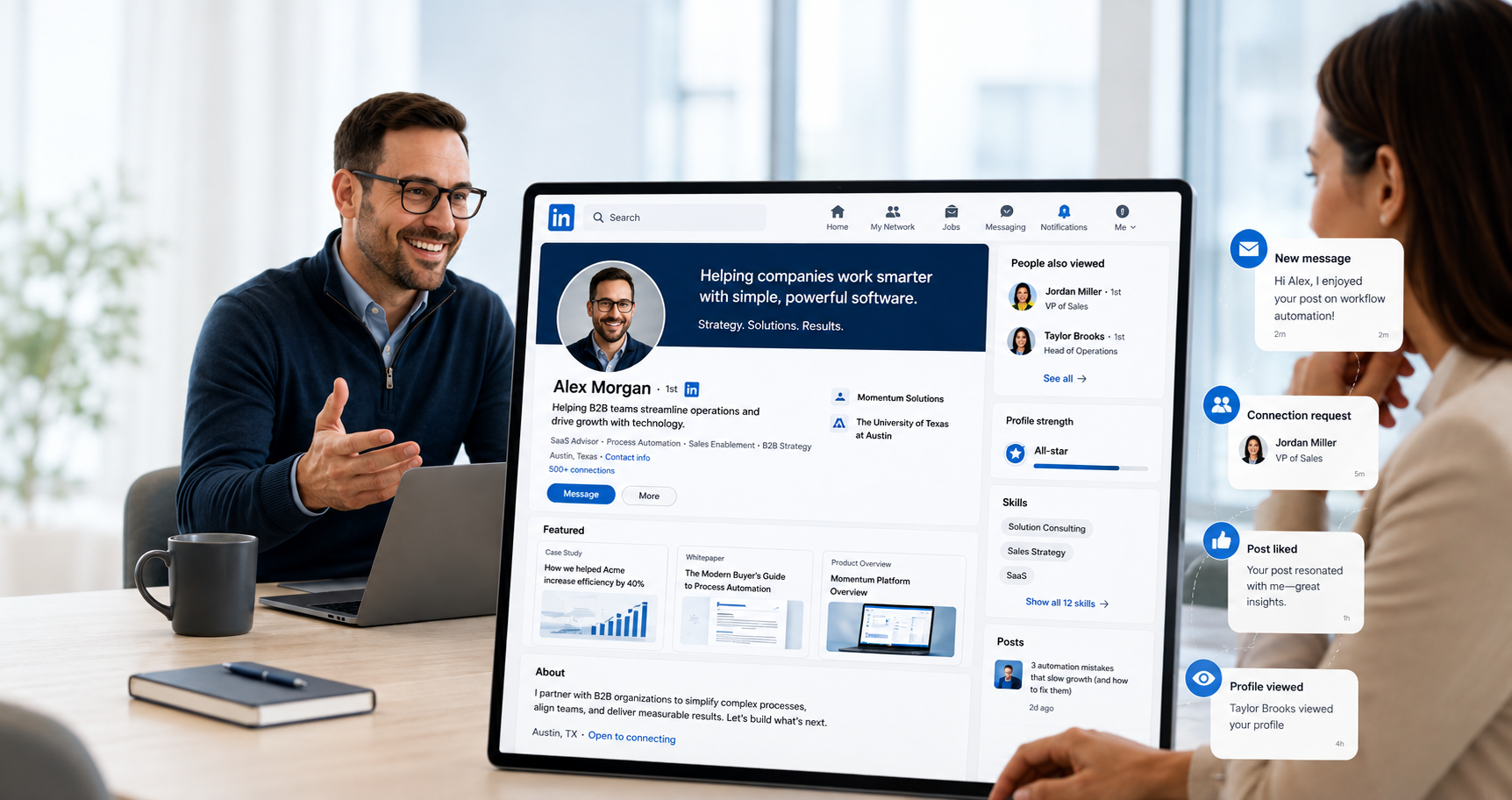
- Then reach out like they’ve known you for months (LinkedIn lurkers, I’m looking at you.
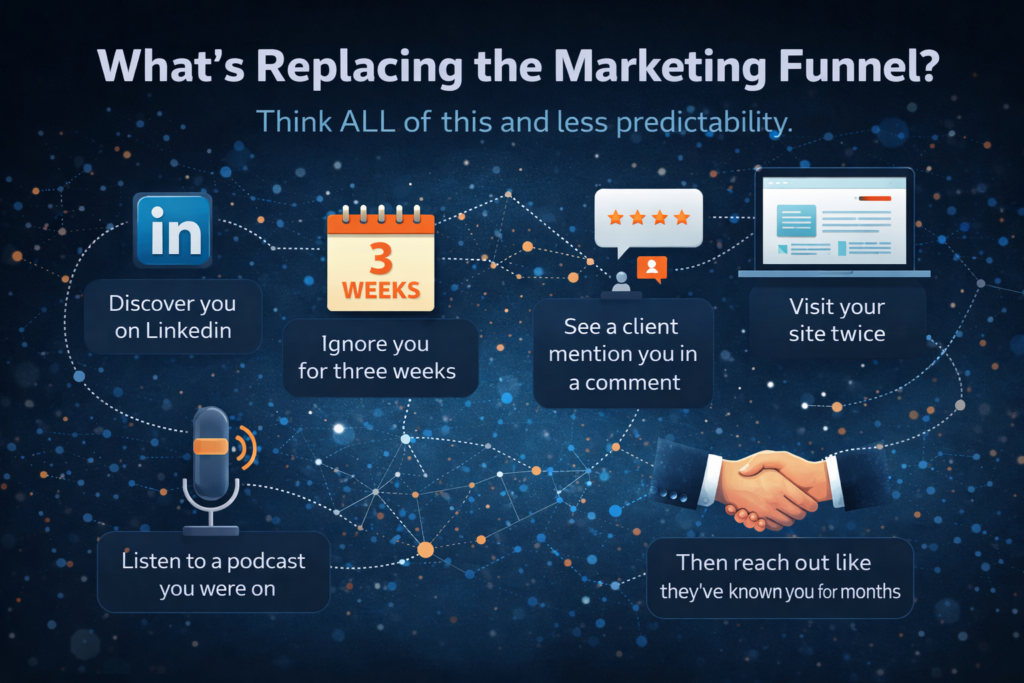
There’s no longer a clean, simple path. There’s no tidy progression that takes someone cleanly through the funnel.
The whole process plays out more like an accumulation or a build up of momentum, all culminating in the final act when the buyer decides you’re the one and makes the purchase.
Traditional funnels can’t handle that. That’s where they break.
What’s Actually Happening Instead
Instead of moving people through stages, modern marketing builds familiarity over time through real relationships.
It’s not accomplished through force. The days of pressure are gone. It no longer focuses solely on perfectly timed nurture sequences.
The key is repeated, meaningful exposure (strategically done, of course). Connections built through authentic, consistent conversations.
Before jumping into tactics, it’s worth understanding the shift at a higher level. What’s replacing the funnel isn’t chaos, although it may feel like it some days. Instead, it’s a different kind of structure. One that’s less visible, but more aligned with human behavior.
- People decide before they “convert”
- Trust builds passively, not just through campaigns
- Buying is often triggered by timing, not persuasion
- Most of the journey happens without you seeing it
This isn’t a funnel. It’s a network of moments. It’s your brand offering value, making lives better, solving problems across a range of touch points, content types, and channels.
The Rise of the “Presence Model”
If the funnel was about guiding people step-by-step, what’s replacing it is about being present at the right moments.
You don’t need to be everywhere. As they say, if you try to be everywhere, you end up being nowhere. You also don’t need to constantly be knocking on your audience’s door. That doesn’t sell, it just makes you the annoying brand.
The key is to simply be consistently visible in ways that matter.
Think of it less like a funnel and more like a field.
People move through it at their own pace. Your job isn’t to push them forward. It’s to make sure that when they look around, you’re there, and your message makes sense.
What It Looks Like in Practice
This shift sounds conceptual, but it shows up in very real ways. It’s playing out all around you. When it’s done right, you don’t even know you’re within the brand’s grasp.
Instead of organizing everything around funnel stages, companies that are growing are focusing on how they show up across the entire experience.
These aren’t tactics for the sake of tactics. They’re patterns you’ll see across companies that understand how modern buying actually works.
- Content that stands on its own (not just gated assets)
- Think resource centers, podcasts, video series
- Messaging that’s consistent across channels
- Consistency is a superpower
- A clear point of view that people can recognize
- Clarity helps people understand the message and recognize it’s coming from your brand
- Visibility in places where decisions are being influenced (not just tracked)
- Be the voice that guides trends and sets the tone
None of this is new on its own. What’s different is how it all connects.
Why the Funnel Feels Like It’s Still Working (Even When It’s Not)
A lot of teams still use funnels because parts of them do work. Funnels still add value, but it goes much deeper, as they don’t account for today’s consumer.
With funnels, you can track conversions, you can optimize campaigns, you can report on performance.
But what you’re measuring is only a slice of what’s happening. If you focus on those areas alone, you’re missing out on the full story.
The truth is, most of the decision-making happens before someone fills out a form. It happens outside your analytics. It happens in conversations you’re not part of.
The funnel captures the end of the journey and calls it the whole thing. That’s why the game is changing and we need to look at funnels in a new way.
What to Do Instead
So, despite the changing face of marketing and the impact that’s had on the traditional marketing funnel, that doesn’t mean you throw everything out.
It means you shift what you optimize for.
Instead of asking, “How do we move people through the funnel?”
Start asking, “How do we show up in a way that builds trust over time?”
That shift changes everything. Trust is currency, and once you build it, you become unstoppable.
To make this practical, there are a few areas worth focusing on. Not as a checklist, but as a way to reorient how you think about marketing as a whole.
- Clarity over complexity: If people can’t quickly understand what you do and why it matters, nothing else works.
- Consistency over intensity: One great campaign won’t carry you. Showing up regularly will.
- Point of view over volume: Saying something clearly beats saying more things more often.
- Visibility over control: You can’t control the journey, but you can influence how often and where you appear.
The Real Shift is From Control to Influence
The traditional marketing funnel was built on control.
Brands control the message, the sequence, and the journey.
Modern marketing doesn’t work that way.
You don’t control the path anymore.
You influence the perception.
And that’s a different skill.
It’s less about building perfect systems and more about:
- Understanding how people think
- Showing up in ways that feel human
- Being consistent enough to be remembered
What This Means for Marketing Going Forward
The funnel isn’t going to disappear overnight. It’s been around for ages, and the concept will apply to marketing still, but it’s not even close to the full picture.
Teams will still use the language. Wannabe influencers on social media will still post about funnels and systems, with little to no real knowledge of what they do.
Platforms will still organize data in a funnel sort of way.
But the companies that grow over the next few years (and way beyond that) won’t be the ones who build better funnels.
They’ll be the ones who understand something simpler.
They will be the ones who understand that people don’t move through funnels. They move toward clarity, trust, and familiarity.
If your marketing creates those things, you don’t need to force the next step.
It happens naturally.
And usually faster than you expect.

Anthony is Founder and Chief Growth & Strategy Officer for E&I Creative. He is a two-time published author and digital marketing influencer. He has helped brands both large and small grow and thrive across multiple industries through strategic marketing campaigns and leveraging a powerful network of influencers.