
There’s a quiet shift happening in marketing right now.
The companies winning aren’t always the biggest. They’re the ones paying closer attention, moving a little faster, and using the tools in front of them a little better.
If you’re leading marketing inside a small to mid-sized organization, that’s good news. Because while enterprise brands still have scale and deep pockets, you have something just as powerful.
You have proximity to your audience, the ability to pivot quickly, and fewer layers between idea and execution.
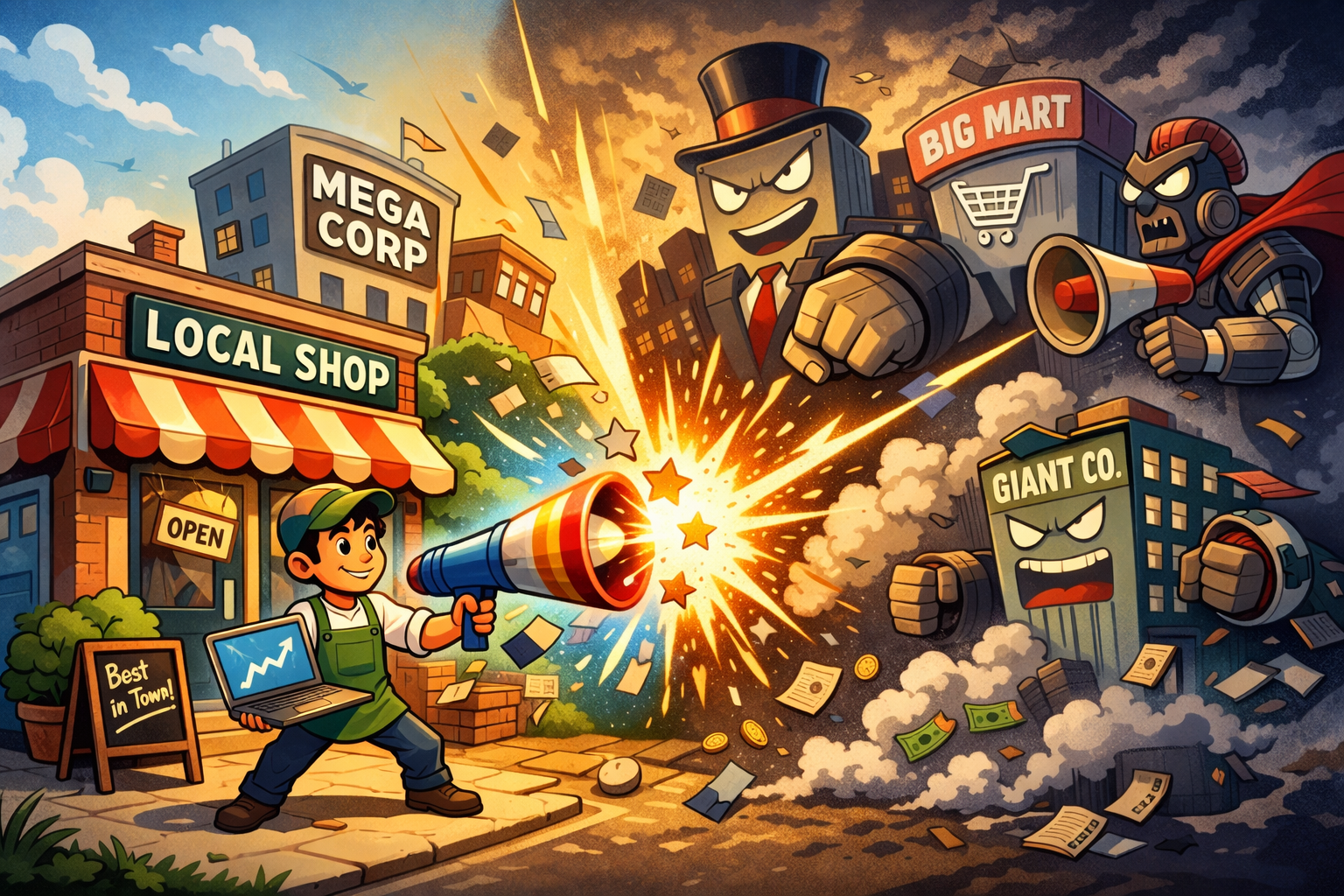
The opportunity isn’t to outspend bigger competitors. It’s to outmaneuver them.
Let’s talk about how you level the playing field and show the bigger players it’s no longer just about size.
To kick things off, going local is more than just a little advantage.
Table of Contents
Local SEO: The Advantage Big Brands Can’t Fully Replicate
When most people think about SEO, they picture massive companies with entire teams dedicated to ranking for broad, competitive keywords.
That’s not your game. Nor should it be for the big players (going too broad can bring attention from all the wrong people).
Your advantage is local intent, and it’s one of the most underutilized growth levers for SMBs.
When someone searches for a service or product “near me” or within a specific region, search engines prioritize relevance and proximity over brand size. That’s where smaller organizations can win consistently (at least the ones who take the time to optimize for local search).
Local SEO isn’t about gaming the system. It’s about clearly signaling who you are, where you operate, and why you’re the best option for a specific community.
Before breaking it down, it’s important to understand that local SEO works best when it’s intentional and layered. It’s not one tactic, it’s a system.
Here’s what that system looks like in practice:
- Optimized Google Business Profile – Complete, accurate, and actively managed. This is often your first impression.
- Localized content that actually matters – Not generic blog posts. Instead, focus on content that speaks to real local needs, events, and questions.
- Consistent NAP (Name, Address, Phone) data across platforms – Small inconsistencies create big trust issues for search engines.
- Reviews that reflect real customer experiences – Not just volume, quality and recency matter.
- Location-specific landing pages – Especially important if you serve multiple areas.
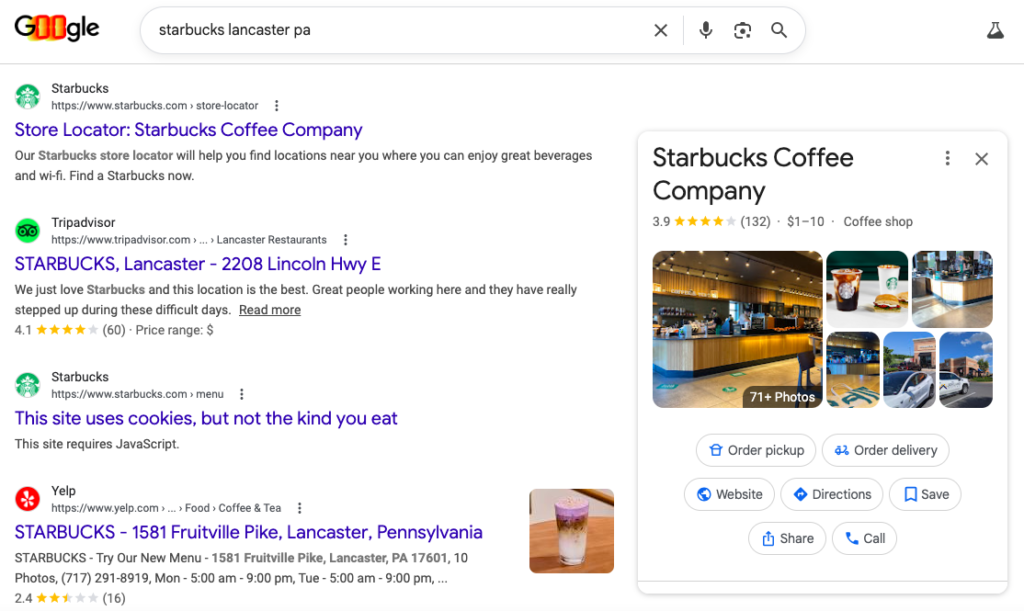
A good example of this in action is how Starbucks dominates local search, not just because of brand recognition, but because every location is meticulously optimized, reviewed, and updated. The difference is, SMBs can do this with more authenticity and community connection.
And that’s the edge. Big companies can scale presence, but they can’t scale genuine local relevance in the same way you can.
From Local Visibility to Operational Leverage
Once you start attracting the right audience through local visibility, the next question becomes obvious.
What happens after they find you?
Traffic without systems in place to turn that traffic into actual business just creates friction. And friction is where opportunities quietly disappear.
This is where marketing and operations start to overlap more than most teams realize. The best marketing today doesn’t just generate attention, it supports the entire customer journey.
Increasingly, that’s where artificial intelligence AI steps in. Stop with the “AI is taking our jobs” or “You’re evil because you used AI” talk. AI is here. Deal with it.
Using AI to Make Marketing (and Everything Around It) Smarter
AI isn’t just a content tool. If that’s how it’s being used in your organization, you’re barely scratching the surface. Yes, it is amazingly useful in this sense, but it has so many other applications.
At its best, AI acts as an amplifier across marketing and operational workflows, helping you move faster without losing quality.
But it only works when it’s applied with intention.
I see a lot of companies making major mistakes in this area. Rather than selecting the right tools, setting processes and standards in places, and leveraging AI with intention, many companies try to implement what seems like any and all AI tools that enter the market.
Before jumping into tools, to avoid the pitfalls, it’s helpful to frame where AI actually creates leverage inside a marketing function.
- Content ideation and refinement – Not replacing your voice, but accelerating your thinking and helping you explore angles you might not have considered.
- Customer insights and segmentation – AI can analyze behavior patterns and surface insights in seconds that would take hours (or days) manually.
- Campaign optimization – Real-time adjustments based on performance data, not just post-campaign analysis.
- Sales and marketing alignment – AI-assisted CRM tools can help prioritize leads, personalize outreach, and reduce lag between marketing and sales.
- Internal efficiency – Automating repetitive tasks so your team can focus on strategy and creative work.
A company like HubSpot has leaned heavily into this, embedding AI into their platform to help businesses automate workflows, personalize messaging, and better understand their pipeline without needing enterprise-level resources.
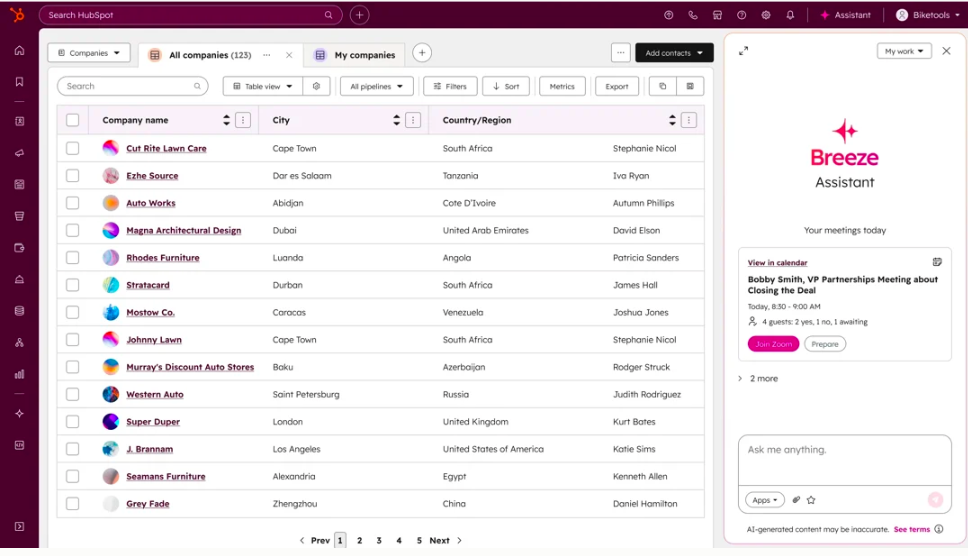
And that’s the key point. AI is lowering the barrier to sophistication.
You don’t need a massive team anymore to operate like one.
Bridging the Gap Between Strategy and Execution
There’s a pattern that shows up often in growing organizations. One that stunts growth and limits potential.
Good ideas exist.
Smart people are in place.
But execution feels inconsistent.
That execution gap isn’t usually about effort, it’s about clarity and systems. You can have the greatest idea in the history of mankind, but if you can’t cleanly and clearly execute it, it will remain an idea, and that’s it.
Often, businesses fail here because they try to get too complex when the real solution is to simplify.
Marketing leaders in SMBs wear a lot of hats. That’s reality. But the goal isn’t to do more, it’s to make what you’re already doing work harder.
This is where tightening your marketing foundation matters.
Before listing tactics, it’s worth grounding this in a simple idea.
Consistency beats intensity.
A few well-executed initiatives will outperform a scattered approach every time.
To bring that into focus:
- Define a clear audience and stick to it – Broad messaging dilutes impact.
- Build repeatable content themes – So you’re not reinventing the wheel every week.
- Align marketing with actual business goals – Not vanity metrics.
- Create feedback loops – Between marketing, sales, and customer service.
- Document what works – So success becomes scalable, not accidental.
This isn’t flashy. But it’s what separates teams and organizations that grow in a steady, sustainable way from teams that feel like they’re constantly starting over.
Where It All Comes Together for SMBs
Local SEO brings the right people in.
AI helps you serve them better and operate more efficiently.
Strong execution ensures none of it gets wasted.
Individually, each of these matters. Together, they create something much more powerful. A marketing system that builds momentum over time until it becomes an unstoppable force. .
And that’s really the shift.
Marketing isn’t about isolated campaigns anymore. It’s about building an ecosystem where visibility, experience, and efficiency reinforce each other.
For smaller and mid-sized organizations, that’s not a disadvantage, it’s an opportunity.
Because while larger companies are often managing complexity, you have the ability to stay focused, move quickly, and build something more connected.
And in this environment, that’s what wins.

Anthony is Founder and Chief Growth & Strategy Officer for E&I Creative. He is a two-time published author and digital marketing influencer. He has helped brands both large and small grow and thrive across multiple industries through strategic marketing campaigns and leveraging a powerful network of influencers.