
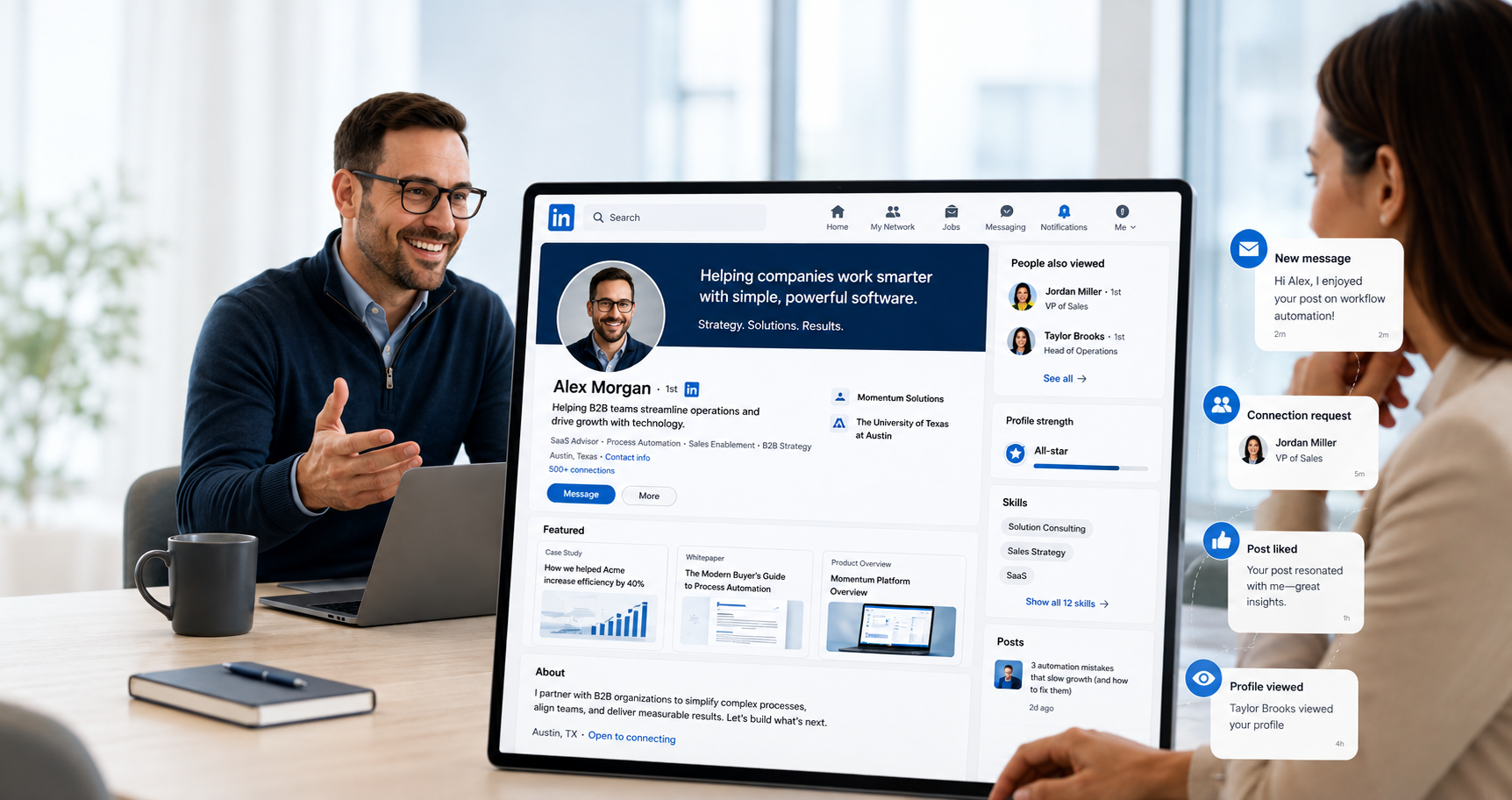
There’s an old vision of how to approach sales that still exists in a lot of people’s heads.
Build a list. Make the calls. Send the emails. Follow up until somebody finally gives in and agrees to a meeting.
And sure, some of that still matters. Salespeople still need to prospect, have conversations, follow up, and eventually ask for the business.
But there’s another part of selling that’s become increasingly important. To figure it out, start by asking this question.
What does the buyer think about you before the conversation even starts?
Because you can assume they’re looking.
Someone receives an email from you. They don’t recognize your name, so they search you. They pull up LinkedIn. Maybe Google. Maybe they click through a few of your posts or look at your company website.
Within a few minutes, they’re forming an opinion.
Do you understand their world? Do you look credible? Do you have anything useful to say? Or do you simply look like another salesperson trying to get onto their calendar?
That’s where personal branding changes the game for you.
And before we have a mutiny on our hands, I’m not saying every salesperson needs to become a LinkedIn influencer.
In fact, I encourage you, please don’t.
Table of Contents
Your Personal Brand Is Already Part of the Sales Process
You have a personal brand whether you intentionally build one or not.You’re alive, and by default, each moment you’re here, your brand grows (or declines).
Your personal brand is the reputation that forms around your name. It comes from the conversations you have, the emails you send, the way you show up online, the expertise you share, and the experiences people have working with you.
Increasingly, that reputation also exists before you ever meet someone.
LinkedIn has reported that 81% of B2B buyers looked at a salesperson’s LinkedIn profile as part of the buying process. Another 32% reviewed content the salesperson had posted, while 31% looked for shared LinkedIn connections.
Much like Ron Burgundy, those stats are kind of a big deal (although they have nowhere near the number of leatherbound books).
Why are the stats so big? It’s not because your LinkedIn profile is going to magically close the deal for you. It won’t. But it might determine whether you ever get the opportunity to have the conversation.
That’s an important distinction.
Personal branding isn’t a replacement for good selling. It makes good selling easier.
Buyers Aren’t Just Evaluating Your Company Anymore
Think about how you make decisions when someone approaches you with something you might buy.
You probably look beyond the company logo. Who is this person? Do they seem knowledgeable? Do they understand the industry? Can I trust them?
And maybe most importantly, this question. Are they going to help me solve something, or am I about to spend the next 30 minutes listening to a product pitch?
Product pitch. Yuck.
Your prospects are doing the exact same thing.
LinkedIn has also reported that 42% of B2B buyers research sales professionals on LinkedIn and 50% avoid sellers with incomplete profiles.
Word of caution. I’m not citing those numbers to tell you, “Fix your LinkedIn profile and your sales will jump 50%.”
That’s not how any of this works..
The takeaway is much simpler. Buyers pay attention to the person behind the pitch.
So give them something good to find.
Personal Branding Is Much Bigger Than Posting on LinkedIn
This is where a lot of salespeople get hung up.
Mention personal branding and people immediately think, “So now I have to post every day?”
No. I mean, I do, but you don’t have to.
LinkedIn can certainly be part of your personal brand, particularly if you sell B2B. But posting is only one piece of a much bigger picture.
Your personal brand shows up in your LinkedIn headline, your About section, and the photo you’ve been using since 2014. It’s in your email signature and the follow-up message you send after a meeting.
It’s in the article you helped your marketing team write. It’s in the comment you left on a prospect’s post. It’s in the presentation you gave at an industry event or the podcast you joined.
It’s also in what somebody finds when they Google your name.
All of those small pieces begin to tell a story. The question is whether you’re intentionally helping shape that story or allowing the internet to do it for you.
A Better Personal Brand Warms Up the Room
Cold outreach is difficult for a fairly obvious reason.
The person doesn’t know you.
There’s no familiarity. There’s no trust. And there usually isn’t much reason for them to stop whatever they’re doing and talk to you.
A strong personal brand doesn’t eliminate that problem, but it can shrink it.
Imagine you’ve spent the past six months sharing useful insights about the problems your customers deal with. Maybe you’ve posted occasionally on LinkedIn, contributed to two articles on your company’s blog, and left useful comments on posts from people in your industry.
Your LinkedIn profile clearly explains the types of problems you help solve.
Now you reach out to a prospect.
They recognize the name. Or they don’t, but they look you up and quickly discover that you appear to know what you’re talking about.
That’s a much warmer starting point.
You aren’t suddenly best friends, but you’re not completely unknown anymore either.
And in sales, reducing even a little bit of uncertainty can go a long way.
Good Content Helps You Sell Without Constantly Asking for the Sale
There’s another advantage to building authority around your name.
You have something useful to talk about besides your product.
This is especially important during longer sales cycles. There are only so many ways to write, “Just checking in,” “Wanted to circle back,” or “Any updates?”
And please, whatever you do, stop “bumping it up”.
Eventually, those emails become background noise.
Useful content gives you another reason to stay in the conversation. Instead of asking for something every time you reach out, you can bring something.
Maybe you send a short article answering a question that came up during the last call. Maybe you share a checklist that helps the prospect prepare for the next stage of the project.
Maybe you send a post where you explained an industry trend that affects their business. Or you record a two-minute video breaking down a common mistake.
Now you aren’t simply following up.
You’re helping.
That difference is small on paper. In practice, it can completely change the way someone sees you.
Your Expertise Is Probably Already There
One of the biggest misconceptions about thought leadership is that you have to constantly invent something revolutionary.
You don’t.
In fact, trying too hard to sound groundbreaking is usually when thought leadership starts to get weird.
The best content often comes from the work you already do every day. Think about the questions prospects ask you repeatedly. Think about the mistakes you see customers making.
Think about the reasons you recommend one approach over another, or a difficult project and the lesson you took away from it.
That’s content that adds real value, and as a result, it stands out from the crowd.
Think about something happening in your industry that your customers should understand.
Also content and also valuable.
High-performing salespeople often accumulate an enormous amount of knowledge without thinking much about it. After you’ve answered the same question 75 times, the answer feels obvious to you.
It may not be obvious at all to your customer.
That’s where the opportunity is.
Buyers Want to See How You Think
The value of sharing expertise becomes even more interesting when you look at modern B2B buying groups.
The person talking to the salesperson often isn’t the only person involved in the decision. There may be people in finance, procurement, operations, IT, leadership, legal, or another department quietly evaluating the purchase.
In a recent report, Edelman and LinkedIn refer to these people as hidden buyers.
Their 2025 B2B Thought Leadership Impact Report found that 55% of hidden buyers use thought leadership when evaluating vendors. The research also found that 41% of target buyers and 35% of hidden buyers had been encouraged by a C-suite executive to consider a particular vendor after that executive encountered the vendor’s thought leadership.
Think about what that means for a salesperson.
The article you contribute to may reach someone you’ve never spoken with. A post may get forwarded inside an organization. Something you wrote three months ago may suddenly become relevant when a buying committee starts discussing a problem.
You’re building influence outside the boundaries of the sales call itself.
That’s powerful.
You Don’t Need to Sound Like a Corporate White Paper
There’s another lesson in the Edelman and LinkedIn research that salespeople should pay attention to.
People want expertise.
They don’t necessarily want it wrapped in 4,000 words of corporate jargon. No synergy, let’s not take this offline, and we aren’t looking to boil the ocean here. Makes you cringe, right?
The 2025 research found that hidden buyers respond to content that is clear, approachable, distinctive, and human.
That’s good news.
You don’t need to suddenly start sounding like an analyst. Write like you talk. Explain something clearly. Have an opinion when you actually have one.
Use examples. Tell people what you’ve learned. Say, “Here’s what I would consider before you make this decision.”
That kind of content often builds more credibility than something polished within an inch of its life.
And it sounds like an actual human being wrote it.
Always a nice bonus.
Suggested Reading: 10 Tools to Supercharge Your Content
Start With the Questions You Already Answer
If you’re staring at LinkedIn on your laptop wondering what to post, close LinkedIn.
Think about your last five customer conversations instead.
What came up? What did someone misunderstand? What question did you answer? What decision were they struggling with?
What did you explain that seemed to click?
Start there.
You could build months of useful content around four simple categories.
- Questions customers ask. Answer the questions you hear repeatedly.
- Decisions customers struggle with. Explain how you think through the options.
- Lessons from the field. Share useful observations from real situations without revealing confidential information.
- Customer problems and outcomes. Talk about the challenge, why it was difficult, how you approached it, and what others can learn from it.
You don’t need to publish all of it yourself either.
Sales and marketing should work together here. A salesperson might bring the raw insight while a marketing person turns it into an article, video, infographic, case study, or social post.
The expertise comes from the person closest to the customer.
Marketing helps package it.
Clean Up the Basics Before You Become a Content Machine
Before worrying about a content calendar, spend an hour cleaning up the foundation.
Google yourself.
What comes up?
Look at your LinkedIn profile from a buyer’s perspective. Does your headline explain what you actually do, or does it simply say “Account Executive”?
Here’s my headline for reference.
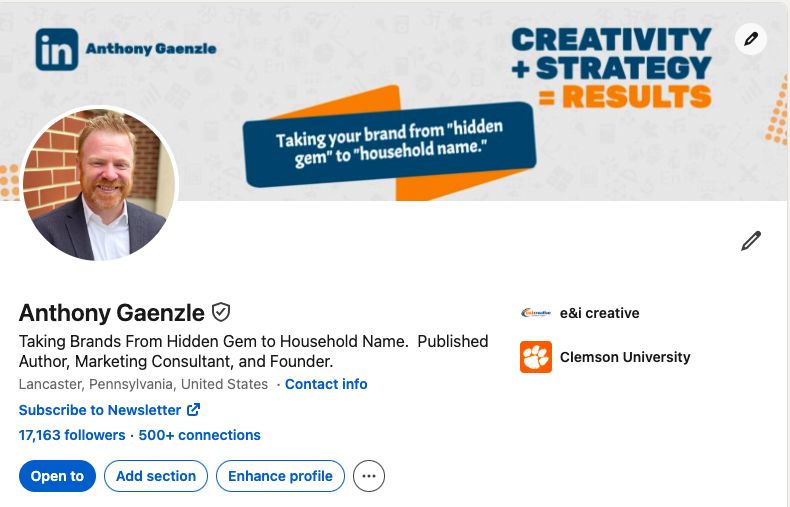
Is your About section current? Does it sound like a human wrote it? Is your profile photo professional and reasonably recent?
Are your company and role correct? Does your Featured section contain anything useful?
Check your email signature too. Make sure links work. Remove outdated titles.
Look for old social profiles and bios that no longer represent you.
None of this is exciting.
That’s precisely why people skip it.
But your online presence is often making an impression while you’re doing something else. You might as well make sure it’s making the right one.
High Performers Do Their Homework, Too
Personal branding works best when it sits alongside another trait strong salespeople tend to share.
That trait is curiosity.
Top performers know their industry. They understand their accounts. They show up to conversations having done more than skimmed the company homepage five minutes before the call.
A 2024 LinkedIn and Ipsos analysis found that 62% of top-performing sellers prioritized learning about an account’s broader industry, compared with only 20% of lower-performing sellers.
That research habit feeds personal branding.
The more you learn, the more useful things you have to say. And the more useful things you have to say, the easier it becomes for people to see you as someone worth talking to.
Research feeds expertise.
Expertise feeds content.
Content builds familiarity.
Familiarity makes conversations easier.
It all connects.
Suggested Reading: Why Great Businesses Still Struggle With Content Marketing (and How to Fix It)
Give Yourself 30 Days
You don’t need to overhaul your entire digital life this weekend.
Give yourself a month.
In week one, clean up your professional presence. LinkedIn, your bio, your photo, your email signature, whatever people are likely to find.
In week two, reconnect with your market. Follow customers. Connect with people you genuinely know. Pay attention to what prospects and industry leaders are talking about, and leave a useful comment when you have something worth adding.
In week three, create one useful piece of content.
One. That number can increase as you get more comfortable, but avoid going from 0 to 100 at first shot.
Answer a customer question. Share a lesson. Contribute an idea to your company blog. Record a short video. Write a LinkedIn post.
Then, in week four, put that content to work. Use it in a follow-up when it actually answers a prospect’s question. Send it to a customer who would find it useful.
Share it with your network. Let marketing repurpose it.
Then do it again.
Not every day.
Not because the algorithm demands it.
Because being useful repeatedly is how people begin to remember you.
The Goal Isn’t to Become a Creator
This is the part I want salespeople to remember.
You’re not trying to build an audience for the sake of having an audience. You’re not trying to become internet famous, and you’re not trying to spend three hours every morning deciding what to post on LinkedIn.
You’re making the expertise you already have easier to see.
That’s it.
The best personal brands don’t feel manufactured. They create a simple connection in someone’s mind.
They think, “That person understands this problem.”
Once enough of the right people begin making that connection, selling gets a little easier.
The email feels less cold. The meeting starts with more trust. The prospect comes in with more context, and the content keeps working after the conversation ends.
Eventually, people may even start reaching out to you before you ever reach out to them.
Company brands create awareness.
People create trust.
For a salesperson trying to become a high performer, building both is a pretty good place to start.
e&i creative is a full-service marketing agency headquartered in Lancaster, Pennsylvania, and serving both B2B and B2C clients across multiple states and regions. The agency offers web design, marketing strategy, social media marketing, graphic design, content marketing, SEO, video production, blogging, and copywriting services.