
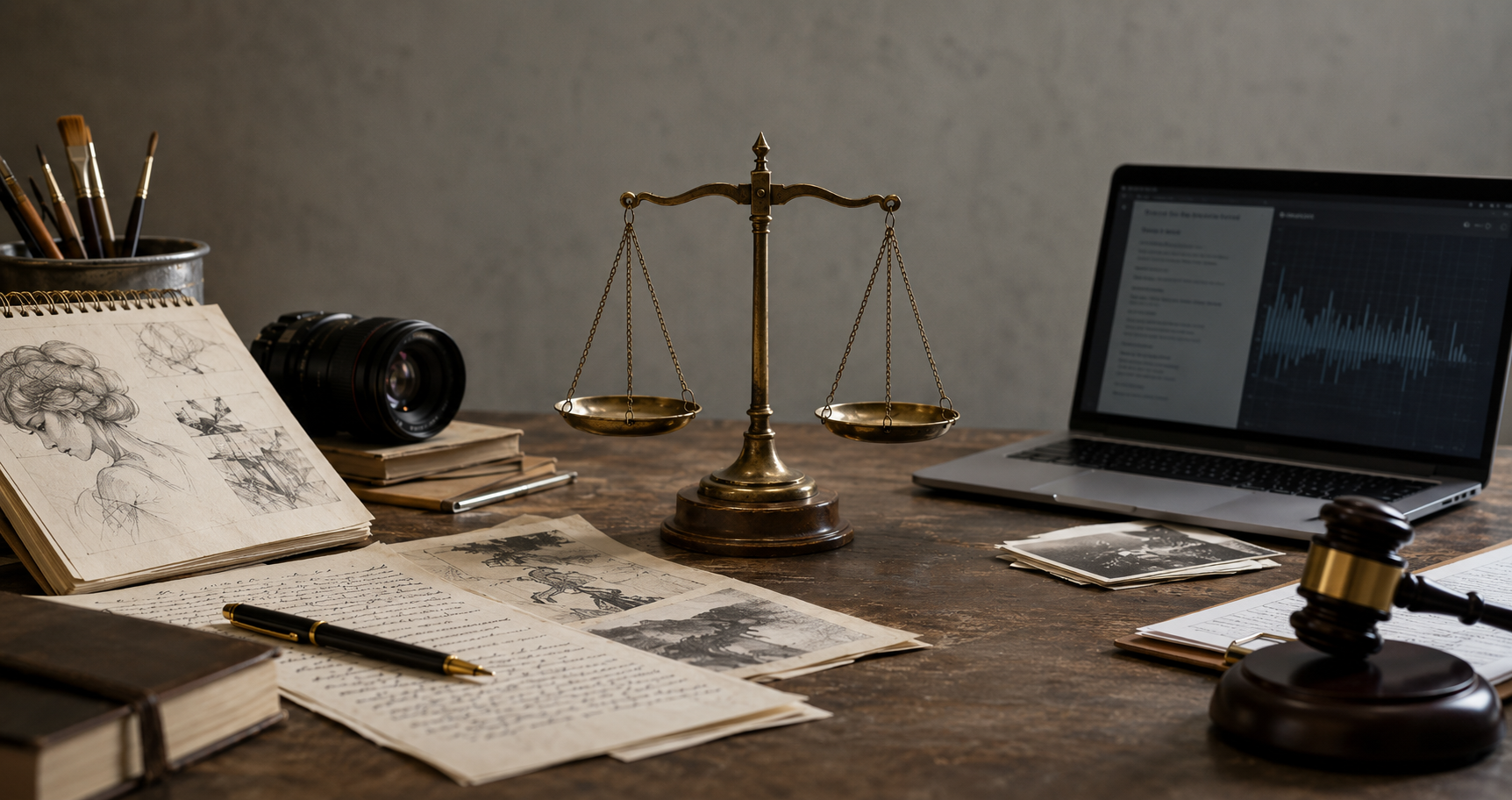
Few topics create an online argument faster than artificial intelligence and intellectual property. I posted recently on LinkedIn about AI, and the conversation quickly exploded. Each side digging in and taking a stance.
One side says AI companies built billion-dollar products by taking the work of artists, writers, photographers, musicians, and other creators without permission or payment.
The other side says AI learns from existing material much like people do. Writers read books. Artists study paintings. Musicians listen to songs. We absorb patterns, techniques, and ideas, then create something new with our own little spin.
Both sides usually arrive armed with absolute certainty. The “gray area” is shrinking more and more with each conversation.
When it boils down to it, however, the truth is less convenient than either side wants to believe.
Some uses of copyrighted work may qualify as fair use. Others may not. Training a model is not necessarily the same thing as copying an article into an output, and using a legally purchased book is not necessarily the same thing as downloading a pirated copy.
We keep trying to turn one complicated question into a yes-or-no answer.
But the thing is, it isn’t even one question to start.
Table of Contents
First, what does “stealing” actually mean here?
The word stealing carries a lot of weight, but people use it to describe several different things:
- Collecting copyrighted work without permission
- Downloading material from pirated sources
- Using that material to train an AI model
- Generating something that resembles a creator’s work
- Reproducing part of an original work in an output
- Building a competing product without compensating the people whose work helped make it possible
Those actions aren’t legally or ethically identical.
Traditional theft removes something from its owner. If someone steals your laptop, you no longer have your laptop. Nightmare scenario, right? Sorry, back to the topic.
When copyrighted work is copied into a training dataset, the creator still possesses the original. That doesn’t automatically make the copying legal, fair, or harmless. It simply means copyright infringement and physical theft are different legal concepts.
Copyright law is primarily concerned with unauthorized copying, distribution, adaptation, public display, and market harm. It also includes exceptions, most notably fair use in the United States.
That’s where the gray area begins. Then the plot thickens from there.
Related Article: The Real Impact of AI on Creators and Business Leaders
The argument that AI training is a form of learning
AI companies and their supporters argue that training does not work like assembling a giant digital scrapbook.
A language model generally isn’t supposed to store every article, novel, or website in a searchable filing cabinet. During training, it analyzes enormous amounts of material and adjusts numerical parameters based on patterns in language.
An image model similarly learns relationships among visual elements, descriptions, styles, shapes, and composition.
Supporters compare this to human learning.
A writer may read hundreds of novels before writing one. A designer might study websites, advertisements, packaging, and photography. Nobody creates in a total vacuum.
This position gained significant legal support in 2025.
In Bartz v. Anthropic, a federal judge ruled that Anthropic’s use of books to train its language models was highly transformative and could qualify as fair use. The judge compared the process to a reader learning from books in order to create something different rather than merely reproducing them. However, the ruling drew an important distinction between training and the way the books were obtained.
A separate ruling in Kadrey v. Meta also favored Meta on the specific fair-use claims presented by the authors. But the judge made it clear that the ruling was not a declaration that all AI training is automatically lawful. The authors had failed to provide sufficient evidence of relevant market harm under the arguments they pursued. A different case with stronger evidence could produce a different outcome.
That qualification is important.
These cases support the idea that using copyrighted material for model training can be transformative. They do not create a blanket rule that every dataset, model, source, and output is protected by fair use.
AI supporters also point to the public benefits.
Models trained on broad collections of information can help people translate languages, analyze data, learn new skills, write software, generate ideas, conduct research, and improve accessibility. Limiting training to public-domain material could leave models with an incomplete understanding of modern culture, science, language, and current events.
There is a legitimate concern that an overly restrictive licensing system could place advanced AI development exclusively in the hands of the largest companies. They’re the organizations most capable of paying for enormous licensing portfolios.
A rule intended to protect creators could inadvertently make the AI industry even less competitive.
The argument that creators’ work was taken without meaningful consent
Creators see the situation differently, and not without reason.
Imagine spending 20 years developing a recognizable illustration style, building a body of work, attracting an audience, and earning a living from commissions.
Then a company gathers your images without asking, uses them to improve a commercial product, and allows users to request new images associated with your name or style.
You may still possess your original files, but that hardly means nothing of value was taken.
The same concern applies to writers, journalists, photographers, voice actors, musicians, and filmmakers.
Their argument is not simply, “The machine read my work.”
It’s that companies copied work at a scale no human could match, incorporated it into commercial systems, offered limited transparency, and frequently provided no practical way for creators to consent, decline, negotiate, or receive payment.
Harvard Business Review identified this problem early, noting uncertainty around the use of unlicensed material, ownership of AI-generated work, and the risk of infringement in both training and outputs. It recommended stronger data governance, provenance tracking, and clearer safeguards around intellectual property.
The U.S. Copyright Office reached a similarly nuanced conclusion in its report on generative AI training.
The Office did not say that all AI training is fair use. It said the outcome depends on factors such as the purpose of the model, the works used, how the material was obtained, the controls placed on outputs, and whether the system competes with the market for the original works.
Its report suggests that noncommercial research or analytical uses may have a stronger fair-use argument. Commercial systems that use vast amounts of expressive work to generate competing content may face a much weaker one, particularly when the material was acquired illegally.
That isn’t anti-technology.
It’s an acknowledgment that “transformative” shouldn’t become a magic word that excuses every method of obtaining and using creative work.
The source of the training material may change the answer
This is one of the most important distinctions in the entire debate.
In the Anthropic case, the court treated the model-training process and the company’s acquisition of books as separate issues.
Training on legally obtained books could be fair use.
Building a permanent library from millions of pirated books was another matter.
The judge concluded that acquiring pirated copies was not excused simply because the company later used them for a potentially transformative purpose. Anthropic later reached a major settlement covering claims related to illegally sourced books, while continuing to maintain that model training itself can constitute fair use.
That gives us a much more useful framework than “AI is theft” or “AI training is always fair use.”
Ask two separate questions:
Was the material obtained lawfully?
Was the material used lawfully?
A company could potentially have a valid argument for the second question and still have a serious problem with the first.
Suggested Reading: How Local Businesses Can Use AI (With Humans in the Loop) to Beat Bigger Competitors
Training is not the same as output
Another source of confusion is that people often combine the training process with what a model generates.
Those are related, but separate, issues.
An AI system might train on copyrighted material and produce a completely original result that shares no protectable expression with any individual source.
It might also produce text, code, music, or imagery that closely reproduces an existing work.
The first situation may support an argument for transformative use.
The second could create a much more conventional infringement problem.
There’s that gray area showing up again.
Copyright generally protects expression rather than broad concepts, genres, techniques, or styles. That means creating something with the mood of a mystery novel or the broad visual characteristics of impressionism is not automatically infringement.
But reproducing distinctive characters, paragraphs, illustrations, melodies, or other protected elements may cross a line.
Memorization makes this more complicated. Researchers have demonstrated that some models can reproduce portions of training data under particular conditions, especially when material appears repeatedly in a dataset or when users intentionally try to extract it. That doesn’t mean every normal output is a copy, but it does undermine the claim that models never retain or reproduce source material.
This is why responsible AI companies need output controls, duplicate detection, data documentation, and clear procedures for copyright holders.
Saying, “The model doesn’t copy anything,” is too broad.
Saying, “Every output is a collage of stolen work,” is also too broad.
What about imitating an artist’s style?
This may be where the legal and ethical arguments diverge most sharply.
An individual artist’s style is generally difficult to protect through copyright alone. Copyright protects specific works and protectable expression, not the general idea of drawing, writing, or composing in a certain manner.
Legally, that may give AI companies and users room to generate material influenced by a style without directly copying a protected work.
Ethically, creators can still have a strong objection.
A living illustrator might not own every use of bright colors, exaggerated eyes, or a particular line technique. But attaching that illustrator’s name to a prompt can feel like using their reputation as a product feature.
The ongoing Andersen v. Stability AI litigation illustrates how unsettled these questions remain for visual artists. As of 2026, the case continues through discovery, including disputes involving training datasets, artist-specific materials, model behavior, and potential evidence related to fair use. The court has explicitly described fair use in the generative-AI context as unsettled.
Something can be difficult to prohibit under current copyright law while still deserving a better business model.
Those aren’t contradictory positions.
The market-harm question may decide much of this
Fair use in the United States involves four factors, but market impact is often especially important.
Does the AI system substitute for the original work?
Does it reduce demand for the creator’s services?
Does it interfere with a legitimate licensing market?
Does it create content that competes directly with the material used for training?
AI companies argue that models generate new material rather than replacing access to the originals. You don’t normally use a chatbot instead of purchasing a specific novel because the chatbot does not provide that novel.
Creators respond that replacement doesn’t need to be that direct.
A company may once have hired an illustrator, copywriter, narrator, photographer, or musician. It can now produce a lower-cost approximation using a tool trained partly on the work of professionals in that same field, or even that specific professional it previously hired.
The original piece of work may still be available, but the market for the creator’s labor can shrink.
The judge in the Meta case recognized that this type of market-dilution argument could potentially be significant. Meta prevailed because the plaintiffs did not adequately prove it in that case; not because the concern was inherently invalid.
This may become one of the most important battlegrounds in future litigation.
So, is AI stealing intellectual property?
Sometimes the conduct surrounding AI development has clearly involved unauthorized copying or illegally sourced material.
Sometimes courts have found the training itself to be transformative fair use.
Sometimes AI outputs may reproduce protected expression.
Sometimes they don’t.
Sometimes a creator may have a legitimate ethical complaint without an obvious legal remedy under today’s copyright laws.
And sometimes claims of theft treat any form of machine learning from copyrighted material as infringement before courts have actually reached that conclusion.
The most honest answer is this:
AI is not inherently an intellectual-property theft machine, but the AI industry has benefited from training practices that often lacked consent, transparency, compensation, and consistent respect for how the source material was obtained.
That’s a lot to absorb, but every word in that sentence has a significant impact.
We shouldn’t pretend every AI output is stolen.
We also shouldn’t pretend the industry’s early approach to creative work was a model of fairness.
A better path forward
This debate doesn’t have to end with banning AI or telling creators to accept that their work is free raw material.
There are reasonable options between those extremes.
AI companies can disclose more about the categories and sources of training data. They can license premium and specialized collections where practical. They can honor machine-readable opt-outs. They can improve attribution, provenance, and output safeguards. They can provide accessible systems for creators to report reproduced content.
Creators and publishers can develop licensing structures that don’t require negotiating separately with millions of individuals.
Users can avoid prompting systems to mimic living creators by name, verify AI-generated material before publishing it, and refrain from treating a generated draft as finished creative work.
Businesses can maintain human review and establish clear policies covering copyrighted inputs, confidential material, attribution, and commercial usage.
None of these steps will resolve every legal question.
They would at least move the discussion away from two groups yelling “theft” and “fair use” at one another while ignoring everything in between.
AI will continue to change how creative work is produced.
The real question isn’t whether we can stop technology from learning from human culture. It’s whether we can build systems that benefit from that culture without treating the people who created it as disposable.
That’s the part we still need to get right.
This article discusses general legal and ethical issues surrounding artificial intelligence and copyright. It is not legal advice. Court rulings and regulations in this area continue to evolve.

Anthony is Founder and Chief Growth & Strategy Officer for E&I Creative. He is a two-time published author and digital marketing influencer. He has helped brands both large and small grow and thrive across multiple industries through strategic marketing campaigns and leveraging a powerful network of influencers.